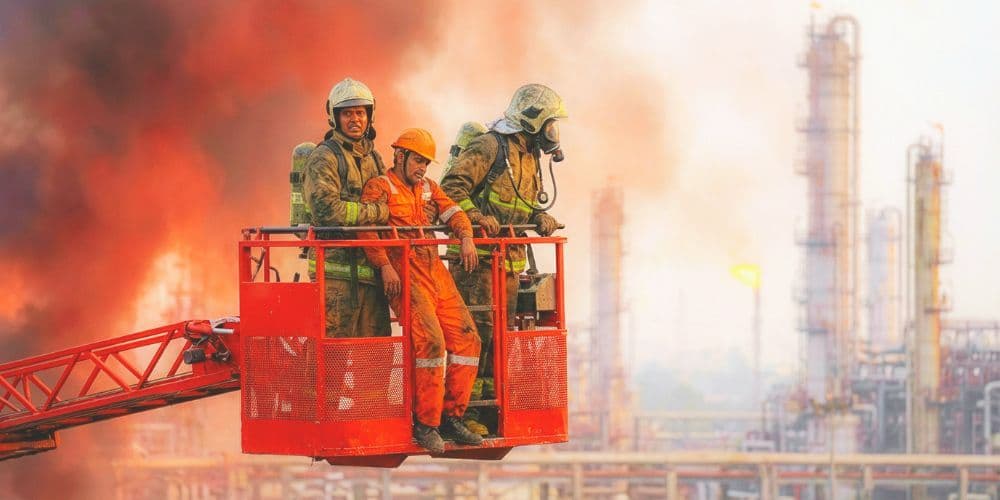
Vapor Cloud Explosions (VCE) remain one of the most significant hazards in facilities handling flammable fluids. When an accidental release results in accumulation of flammable cloud in congested areas, ignition of the cloud can lead to rapid flame acceleration. This rapid combustion produces a blast wave that generates overpressure, which may be capable of damaging buildings and structures located within or near the processing areas.
Understanding how this overpressure develops and how it affects structures is therefore essential for plant layout decisions, facility siting and the design of buildings such as control rooms, substations and administrative blocks.
The severity of a vapor cloud explosion is influenced by factors such as congestion, confinement, fuel reactivity and flame acceleration mechanisms. These factors determine how rapidly combustion spreads through the vapor cloud and how much pressure is generated during the VCE.
In the Flixborough disaster, an explosion occurred at a chemical plant close to the village of Flixborough, North Lincolnshire, England, in June 1974. The blast caused the collapse of the main control building, and 18 out of 28 fatalities occurred inside the building. The incident highlighted critical safety concerns, including poor siting of buildings, lack of blast-resistant construction and high occupancy.
Predicting blast loads on buildings therefore requires careful assessment. Overprediction of potential loads may result in costly overdesign, while underprediction may leave buildings and personnel inside them vulnerable.
Approaches for Determining Blast Load Impacts on Buildings
Two approaches are commonly used to determine blast load impacts on buildings: consequence-based assessment and risk-based assessment. These approaches differ in their focus, methodology and analytical requirements.
Current Design Practices for Plant Buildings
Existing design practices such as OISD 118 and 163 specify typical separation distances and overpressure tolerances for buildings within industrial facilities. Control rooms are typically designed for approximately 3 psi of overpressure and are to be located about 30 metres from plant areas. Service buildings are generally located 60 metres from plant areas, while substations are often located 15 metres away.
However, detailed classification and clearly defined overpressure criteria are not always available for several categories of service buildings. These include operator shelters or cabins located close to plant areas, substations or local electrical and instrumentation rooms, and administrative buildings, laboratories or workshops.
Challenges in Building Overpressure Design
Designing buildings to withstand explosion overpressure in process facilities presents several challenges. Prescriptive spacing criteria may not be adequate for all types of process facilities, particularly those with limited plot areas or modular, muti-level designs handling reactive materials.
Assessing blast loads becomes especially difficult when evaluating existing buildings. Over time, facilities may undergo debottlenecking, revamps or capacity expansion and, building occupancy may increase. These changes can elevate the risk to both buildings and their occupants and therefore must be carefully considered during blast assessments.
Similarly, when new buildings are introduced as part of revamp projects, the cumulative risk assessment should account not only for the hazards associated with the new installations but also for the potential blast effects originating from existing process facilities.
Risk-based Acceptance Criteria
Risk-based approaches commonly use acceptance thresholds for different categories of building. Occupied plant buildings are typically designed for blast loads corresponding to a threshold frequency of 1 in 10,000 per year based on guidance from Chemical Industries Association in Guidance for the location and design of occupied building on chemical manufacturing sites (CIA/CISHEC, 1998).
Administrative or high-occupancy buildings are generally designed for blast loads corresponding to a lower threshold frequency of 1 in 1,00,000 per year, as occupants are not in control of the plant operations and occupancy levels may be relatively high. Operator shelters or cabins may be evaluated at risk levels around 1 in 10,000 per year or higher, depending on their limited occupancy and proximity to process area. For critical support buildings, asset-based risk criteria may be considered. These criteria can supplement consequence-based approaches in the design and assessment of buildings subjected to explosion overpressure.
Modelling Vapor Cloud Explosions
Several modelling methods are commonly used to predict overpressure generated by vapor cloud explosions.
The Baker–Strehlow–Tang (BST) method predicts explosion pressure using parameters such as confinement, congestion and fuel reactivity. Flame speed is selected based on characteristics of the Process Equipment Space (PES). Confinement may be categorised as two-dimensional, two-and-a-half-dimensional or three-dimensional conditions, while congestion levels may be classified as low, medium or high.
The TNO Multi-Energy Method (MEM) represents peak side-on overpressure as a function of distance from the blast centre. Explosion severity is represented by a strength index ranging from 1 to 10, corresponding to conditions from very weak explosions to near-detonative behaviour. Curve-selection methods such as those developed by Kinsella and by Roberts and Crowley are used to determine appropriate severity levels.
Computational Fluid Dynamics (CFD) modelling provides a more detailed method for analysing explosions. CFD models consider the actual three-dimensional geometry of facilities and capture the effects of congestion and confinement while solving governing equations of fluid flow, turbulence and combustion that describe explosion behaviour. CFD modelling can also be used to evaluate mitigation measures such as fire or blast walls. For onshore facilities, CFD based modelling is suitable for modular facilities with high congestion and reactive materials, where simplified models maybe be inadequate. However, CFD simulations are computationally intensive and require significant processing time & expertise.
Case Study: Compressor Shelter
One example analysis considers a compressor shelter with dimensions of 50 metres in length, 20 metres in width and 10 metres in height. Two release scenarios are analysed: methane and hydrogen. The methane case represents a fuel with relatively low reactivity, while the hydrogen scenario represents a highly reactive fuel. Explosion modelling evaluates vapor cloud volumes of 1,000, 4,000 and 8,000 cubic metres to assess the resulting overpressure.
Comparison of Predicted Overpressure
Predicted overpressure levels may vary depending on the modelling approach used. Common methods include the Baker–Strehlow–Tang (BST) method and the TNO Multi-Energy Method (MEM), each of which may produce different results for the same scenario. This variability highlights the importance of careful parameter selection in overpressure modelling.
Assessing explosion overpressure is an important part of designing safer industrial facilities. Consequence-based assessment provides a simple and efficient method for preliminary design but may produce conservative results and is sensitive to the representative scenario used.
Risk-based assessments, on the other hand, consider a wider range of scenarios, enabling risk-optimised design, although they require more detailed data and analysis.
In conclusion, consequence-based approach for building design can be effectively supplemented by risk-based approach, and where appropriate, results can be further validated using CFD modelling for a more accurate and balanced assessment.
For onshore facilities, CFD based modelling is particularly useful for highly congested facilities handling reactive materials, with focus on near field overpressure impacts.
This article is based on a technical paper presented by Rahul Sinha, Senior Consultant and Jishnusankar KS, Consultant, NOVO IRESC India Pvt Ltd, at the International Process Safety Conference 2026 organised by ENCIS and co-organised by ITEN Media.