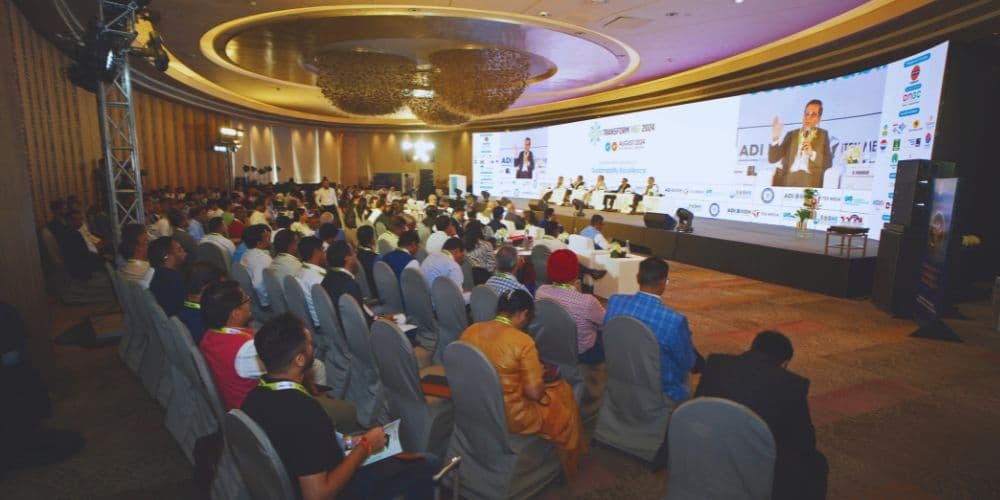
Transform HSE 2025 brought together industry leaders, policymakers and HSE practitioners at a moment when safety, sustainability and business strategy are rapidly converging. The conference examined how leadership-driven HSE is emerging as a critical enabler for achieving the SDGs, strengthening organisational resilience, and shaping the next phase of responsible industrial growth in India. Organised by ITEN Media in association with The Energy & Climate Initiatives Society (ENCIS) and supported by the Society for Occupational Safety, Health and Environment Professionals (SOSHE) and the Bharat Health, Safety, Sustainability and Environment (HSSE) Council, the event was held in New Delhi on April 16–17, 2025.
When Health, Safety and Environment Entered the Boardroom
The conference opened with a clear leadership message. Raman Srivastava, Sr VP (F&S and RCA & RM), Indraprastha Gas Ltd emphasised that safety must be led from the top supported by continuous training and embedded in boardroom agendas. Connecting Health, Safety and Environment (HSE) to Sustainable Development Goals (SDG) 8 for Decent Work and Economic Growth, he said a strong safety culture not only prevents risk but also creates dignified employment and sustainable economic growth.
Sitanshu Sekhar Roychowdhury, VP for Operations & Maintenance at Mahanagar Gas Ltd linked HSE to SDG 3 (Good Health and Well-being), stressing that physical and mental health are now central to business performance. He highlighted the reduction of carbon footprints and greenhouse gas (GHG) emissions as operational priorities. The official also insisted that HSE must be owned across departments through shared accountability and cross-functional training.
A global perspective came from Binayak Panda, VP–HSE & Sustainability, Process Industries, ABB, who viewed leadership maturity determines how deeply safety is embedded in organisations. He noted: while Europe and North America have institutionalised safety and Singapore leads Asia in enforcement, India has made strong progress over the last decade and can emerge as a global HSE leader with sustained leadership focus.
Mohd Najibur Rahman, Group Head – ESG & Sustainability, Jakson Group, remarked that without genuine leadership commitment, safety initiatives fail to sustain. He added that many HSE professionals lack strategic influence despite technical expertise, making leadership sponsorship essential for safety to move beyond compliance.
Operations as Proof of Intent
Across sectors, leaders reinforced that safety and productivity are inseparable. Sanjib Biswas, Director, MO-LPG at Oil Industry Safety Directorate said operational efficiency improves only when safety is built into every stage of work, urging organisations to treat investments in machinery and technology as long-term enablers rather than costs.
Mukesh Mohan, Executive Director – HSE at Indian Oil Corporation Ltd’s Refinery HQ, stressed that ignoring near-miss incidents leads to reputational and financial damage.
PS Murthy, Former Executive Director – HSE (Corporate), Hindustan Petroleum Corporation Ltd stressed embedding safety into Standard Operating Procedures (SOPs) and monitoring systems supported by early-risk detection technologies.
For Himanshu Pant, Executive Director, Special Duty under Director T&FS, Oil and Natural Gas Corporation Ltd behavioural safety and regular SOP updates remain critical to managing evolving risks.
Vijay Goel, Regional Executive Director, Eastern Region I at NTPC Ltd highlighted personalising safety by linking it to family well-being as the strongest driver of workforce ownership.
Expanding the Meaning of Safety and Well-being
Safety discussions extended beyond physical risk to include inclusion and holistic well-being. Dr Urvashi Prasad, Former Director, NITI Aayog said integrating differently abled individuals requires intent, flexibility and dignity, noting that inclusion unlocks productivity and innovation.
Dr Basanta Kumar Behera, Chief Medical Officer, NTPC Ltd linked employee well-being to the SDGs and Environmental, Social and Governance (ESG) framework, stressing that non-communicable diseases now dominate workplace health risks. He urged individuals to take responsibility for personal health beyond mandatory Occupational Health and Safety (OHS) requirements.
Dr R Rajesh, Group Head for Medical & OH Services described workplace wellness as an ecosystem encompassing physical, mental and emotional health, detailing Reliance Industries Ltd’s ‘We Care’ programme and the measurable link between well-being, productivity and retention. Dr Gaurav Saxena, Chief Medical Officer at JCB India Ltd added that psychological safety is the missing pillar of workforce resilience, directly influencing engagement and long-term performance.
Health, Safety and Environment meets Environmental, Social and Governance
A defining theme was the merging of HSE and ESG into a single operational agenda. Priyanka Katoch, VP for SHES in Asia at Orica Ltd explained ESG as the integration of environmental responsibility, social accountability and governance. She noted that HSE professionals are best placed to lead this transition if they strengthen financial and legal understanding.
Mahesh Chandak, Head of SSHE & Site Services at Bayer South Asia highlighted climate risks to agriculture, citing irregular rainfall, methane emissions and water-intensive crops. He pointed to tradable carbon credits and circular economy initiatives as practical pathways to Net Zero emissions.
Dr Pramod Pandey, Global Health & Safety Engineering Leader at Philips said ESG integration is complex, especially in high-emission sectors such as healthcare, stressing lifecycle eco-design, centralised data platforms and supplier engagement.
For Rajendrakumar Patil, Head for Corporate Safety at Asian Paints, HSE culture remains the behavioural foundation of ESG, without which sustainability frameworks remain theoretical. Pandey also recommended the Kaizen or continuous improvement approach for long-term integration, beginning downstream with suppliers.
Technology becomes Safety Infrastructure
Technology emerged as a core safety system rather than a support tool. DP Nanda, CGM for HSE at GAIL India Ltd detailed how Supervisory Control and Data Acquisition (SCADA) and Internet of Things (IoT) systems enable real-time leak detection, while Polyethylene (PE) pipelines reduce corrosion risks in City Gas Distribution (CGD) networks. Training, public awareness and global learning, he said, remain equally critical to reliability and fire safety.
A Srinivasa Reddy, Noida International Airport, described how a tragic incident led to mandatory mental health screening, counselling support, stricter access control and life-saving governance rules, redefining safety beyond physical hazards.
Schneider Electric’s Global EHS Director Pawan Singh explained how Artificial Intelligence (AI)-led predictive analytics and digital monitoring are reducing waste, emissions and operational risk simultaneously.
At Maruti Suzuki India Ltd, DGM Safety Manish Kumar Pandit outlined a 360-degree safety strategy spanning factories, roads and communities through design-stage risk assessment, training, behavioural campaigns and data-driven monitoring.
Crisis Readiness and Aviation Safety
Aviation and infrastructure leaders stressed that crisis is a constant condition, not an exception.
Jasmini Chandran, Head, Aviation Safety at Noida International Airport highlighted the use of IoT sensors, AI, automation and digital twins for predictive safety and simulation-based emergency drills, while warning that communication failure remains the biggest risk during crises.
Kevin Chothani, Head, SHES, Sekura India Management Ltd, EAAA Alternatives emphasised certification-led competence, including the Certified Safety Professional (CSP) credential, as essential for crisis leadership. Ajay Tiwari, Assistant Vice President & Group Safety Head at Birla Corporation Ltd flagged the risks associated with ageing industrial plants, while Vice President for Safety at HPCL-Mittal Energy Ltd Hector Salazar showed how AI-enabled Closed-circuit Television (CCTV) monitoring and digital communication tools now provide early warnings and faster crisis response.
Somya Gandhi, Senior Team Lead for EHS Excellence at Zomato Ltd linked Corporate Social Responsibility (CSR) initiatives, safety reporting and GHG emission reduction into a single accountability framework. Yogesh Srivastava, VP for EHS at Tata Projects Ltd tied strong HSE practices directly to productivity, regulatory compliance, reputation and talent attraction. Transform HSE 2025 made one reality clear: the future of HSE will not be decided by frameworks alone, but by leadership behaviour. As HSE, ESG and digital technologies converge, the organisations that treat safety as strategy, rather than compliance, will define India’s next phase of sustainable industrial growth.
Leadership Imperatives Emerging from Transform HSE 2025
- Move HSE to the Boardroom Safety must be owned by top leadership, discussed at board level, and linked to business performance, not treated as an operational checklist.
- Integrate Safety with Strategy HSE and ESG, and sustainability must function as one system aligned with growth goals.
- Invest before Incidents Occur Prioritise training, technology and infrastructure as preventive investments, not post-incident costs.
- Redefine Well-being Holistically Expand safety beyond physical harm to include mental health and long-term environmental exposure.
- Use Data as a Safety Asset Track near misses, behaviour and system risk, not just incidents, to enable predictive decision-making.
- Build Accountability across the Value Chain Extend HSE responsibility to suppliers, contractors and partners to create scalable, system-wide impact.
- Leverage Technology as a Safety Partner Use AI, IoT, digital twins and analytics to anticipate and prevent risk.
- Strengthen Crisis Readiness Conduct regular drills, certify leaders, and invest in communication systems to manage high-impact events effectively.
- Lead through Behaviour, Not Policy Make safety visible, personal and non-negotiable through leadership actions and everyday decisions.
- Commit Beyond Compliance Shift from rule-based safety to purpose-driven leadership that embeds safety into organisational culture and identity.