India’s industrial transformation is unfolding in a world no longer defined simply by volatility but by the fragility and non-linearity of what thinkers describe as a Brittle, Anxious, Non-linear and Incomprehensible (BANI) operating environment. This shift demands safety systems that are anticipatory rather than reactive, cultures that reward transparency rather than silence, and leadership that sees health, safety and environment as engines of long-term value.
Industry voices across energy, infrastructure, manufacturing and logistics emphasise that national ambitions, including Net Zero emissions by 2070 and the vision of a developed India by 2047 are inseparable from the way organisations protect people, manage risk and steward natural resources.
From Compliance to Strategic Value
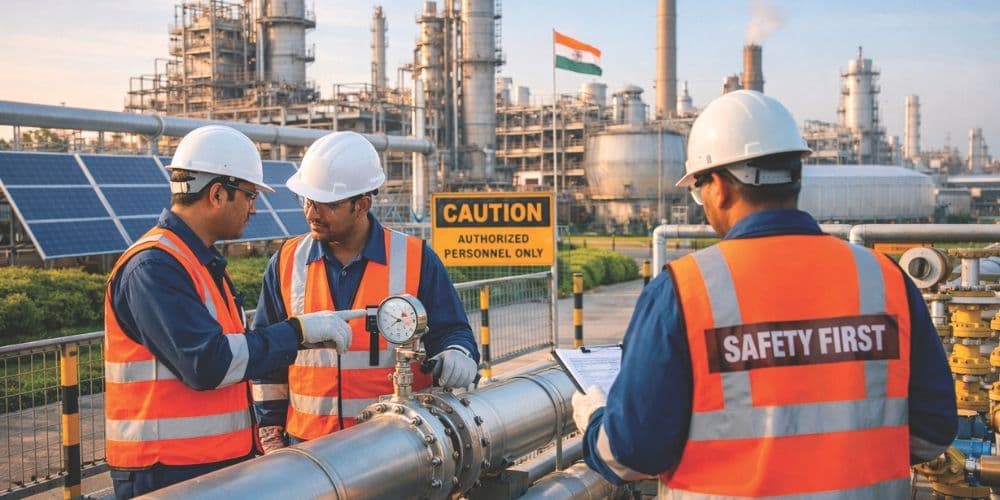
Across organisations, Health, Safety And Environment (HSE) are increasingly viewed as strategic enablers rather than procedural obligations. Senior practitioners caution that common slogans such as “Safety First” or “Zero Harm” often create the opposite of their intended effect when they lead employees to fear repercussions for reporting incidents.
The emerging emphasis is on openness, trust and honest communication. This cultural shift is reflected in a movement from blame to inquiry. When employees report near misses freely, managers can study systemic weaknesses and prevent major events. Leadership is being asked to demonstrate empathy, assume shared responsibility and treat safety with the same seriousness as financial performance. Board-level attention has become central to maintaining this accountability.
Technology as a Predictive Partner
Digital tools are quietly reshaping the practice of safety. Artificial Intelligence (AI) systems are now capable of monitoring sensors continuously, identifying deviations and enabling early intervention long before incidents escalate. In sectors dependent on transport and field operations, technologies such as Global Positioning System (GPS) vehicle tracking, driver-behaviour analytics and fatigue monitoring help reduce accidents and encourage consistent safety discipline.
Additional systems—gas detectors, flame detection sensors, leakage monitors and improved weather-alert tools—strengthen preparedness and reduce operational downtime. This new technological landscape only works, however, when combined with skilled interpretation, practical governance and clear escalation pathways. Extended Reality (XR) training platforms enable immersive simulations that allow employees to practise hazardous tasks safely, build muscle memory and achieve uniform competency levels across geographically dispersed teams.
Wellbeing as a Foundation of Industrial Strength
Indian industry is broadening its definition of safety to include mental, psychological, spiritual and physical well-being. Organisations are investing in programmes that promote mental health awareness, fatigue management, and preventive health screening.
These initiatives are increasingly seen as long-term strategies to reduce absenteeism, build loyalty and support the performance of younger workforces that prioritise psychological safety. Workplaces that provide open channels for discussing stress and emotional wellbeing, create inclusive facilities and integrate differently-abled workers demonstrate organisational maturity and resilience. This approach reinforces the idea that a healthy workforce is not a soft aspiration but a driver of productivity and stable operations.
Environmental Responsibility and Net Zero Imperatives
Environmental performance is becoming a core operational metric rather than an external reporting exercise. Many organisations are adopting time-bound climate targets, including Net Zero Scope 1 and Scope 2 emissions by 2037 and Net Zero Scope 3 emissions by 2040, ensuring that decarbonisation becomes embedded in everyday decision-making. Practical decarbonisation steps include electrification of processes where feasible, development of green hydrogen systems, use of data-driven greenhouse-gas measurement and application of AI for emissions optimisation.
Besides, circularity is gaining prominence. Organisations are increasingly adopting wastewater recycling, strengthened water treatment, rainwater harvesting and multimodal logistics planning as part of sustainable scaling. Direct emissions reduction is prioritised ahead of carbon credits. Supply chains, especially tier-I and II suppliers, are expected to adopt aligned practices with support through incentives and capacity-building programmes.
Operational Discipline and Continuous Learning
Operational excellence begins with frontline empowerment. Organisations are encouraged to develop decentralised safety systems in which workers can identify hazards, raise concerns and propose preventive actions. Standard Operating Procedures (SOP) must be clear, concise and reviewed regularly. Deviations from these procedures signal systemic issues requiring revision rather than individual fault. Frequent emergency drills, structured communication systems and scenario planning strengthen preparedness in a world where crises may emerge suddenly and evolve unpredictably.
The ability to learn, adapt and anticipate change remains essential. As risk environments become more fluid and interconnected, organisations must cultivate habits of listening, reflection and shared responsibility at every level.
A Shared Commitment to National Progress
India’s industrial evolution depends on coordinated action across public institutions, private enterprises and civil society. Environmental damage already costs the global economy more than $8.1 trillion annually, reinforcing the urgency of embedding sustainable and responsible practices across sectors. Unified effort, shared knowledge and collaborative solutions are indispensable. Progress will require consistent leadership, transparent systems and cross-sector partnerships capable of turning aspirations into outcomes.
India’s industrial future is being shaped by a deep cultural and operational reorientation—one in which safety, wellbeing and environmental care drive resilience and competitiveness. The country’s long-term success hinges on whether organisations embed these principles into everyday decisions, align technology with human judgement and cultivate cultures that value openness and learning. A safer and more sustainable industrial landscape is within reach, provided this commitment is shared, sustained and acted upon with clarity and purpose.