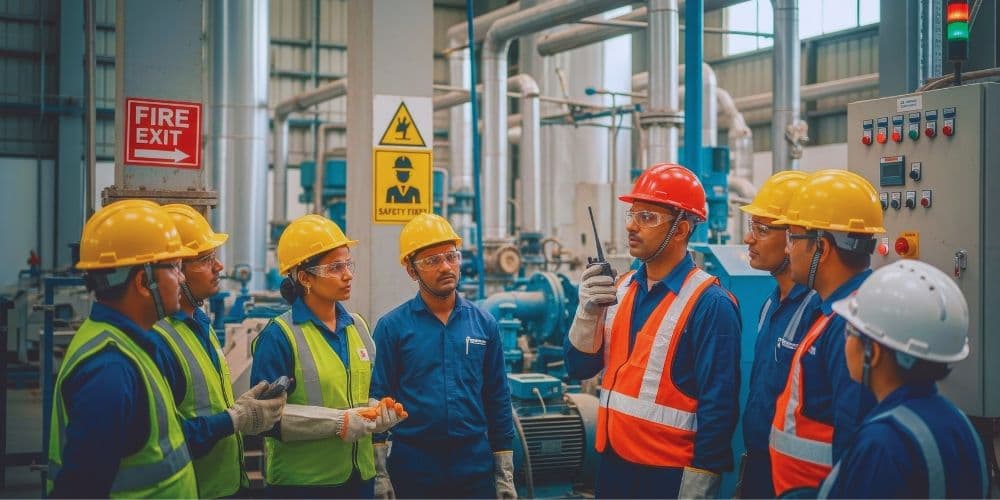
Artificial intelligence in industrial safety is positioned as an amplifier of human judgement rather than a replacement for it. The Intero Safety Assistant developed by Cloudfinch Information Technologies brings together language processing, contextual reasoning, and historical safety data to support professionals when quick decisions are required. The system links everyday signals from the field with structured enterprise processes so that risks are recognised and acted upon in a consistent manner.
Scale of the Data Environment
The Health, Safety, Security, Safety, and Environment (HSSE) portal underpinning the platform aggregates information from more than 80 modules to create a single source of truth. The environment includes over 25,000 incidents, more than 5,00,000 audit items, over 10,000 Hazard Identification and Risk Assessment (HIRA) assessments, and more than 2,40,000 corrective and preventive actions. It covers more than 4,000 employees, 15,000 workers, and 500 locations, along with over 180 Global Reporting Initiative (GRI) disclosure points. This body of data forms the knowledge base used by the assistant for analysis and recommendations.
Connecting Processes into One Workflow
Safety activities such as incidents, audits, behaviour-based observations, and risk assessments are channelled into a common sequence of capture, assign, act, and close. Each stream is designed to lead directly to the creation of a Corrective and Preventive Action (CAPA), ensuring that individual observations translate into traceable actions rather than remaining isolated records.
How the Intero Assistant Operates
The assistant is built to listen and speak in ten Indian languages, perceive context, guide users in real time, and learn through feedback loops. Intelligence is organised through specialised agents covering HIRA, Incident, Behaviour Based Safety (BBS), Training, Audit, and Health functions, coordinated by an orchestrator agent. The approach represents a move from systems that merely store information to systems that reason with it.
Field Reporting Workflow
The platform enables frontline workers to report hazards in their own language through voice input. A spoken message about smoke near a motor can be transcribed, translated, linked to a specific location, and classified automatically. The workflow is designed to generate a corrective and preventive action record and alert relevant fire and maintenance teams without requiring manual data entry. This approach is intended to reduce the time between observation and organised response.
Support for Safety Managers
For safety managers, the assistant aggregates information from incidents, audits, and behaviour-based observations to provide structured insights. Instead of spending most of their effort on documentation, managers are supported with trend analysis, pattern recognition, and suggested preventive measures.
The system can recommend actions such as replacing damaged insulation, adding thermal sensors, or revising maintenance routines, helping teams focus on prevention and workplace culture.
Investigation and Pattern Recognition
The assistant assembles an incident case by drawing together voice inputs, images, logs, and locations into an overview with a sequence of events.
It compares the case with over 25,000 earlier incidents and contextual factors to surface recurring signals. Recommended controls are generated in layers covering engineering measures, administrative steps, and PPE or training, ranked by impact and effort.
From Compliance to Learning
The platform frames safety transformation as a progression from compliance to continuous learning and from learning to resilience. Every incident becomes a new layer of organisational wisdom, every worker an active participant in prevention, and every decision guided by shared situational awareness.
The Intero Safety Assistant shows how multilingual reporting, historical safety records, and agent-based reasoning can be combined to support responses to fire-related risks. By converting observations into structured actions and guidance, the system seeks to help safety teams focus more on prevention while maintaining disciplined and traceable workflows.
This case study is adapted from the presentation ‘AI Assistants for Fire Safety: Domain-specific AI for Safety Professionals, EHS Leaders, and Industrial Enterprises’ by Nitin Ramamurthy, CEO, Cloudfinch (www.intero.ai), delivered at the Bharat Fire & Safety Congress 2025 organised by ITEN Media in association with ENCIS.