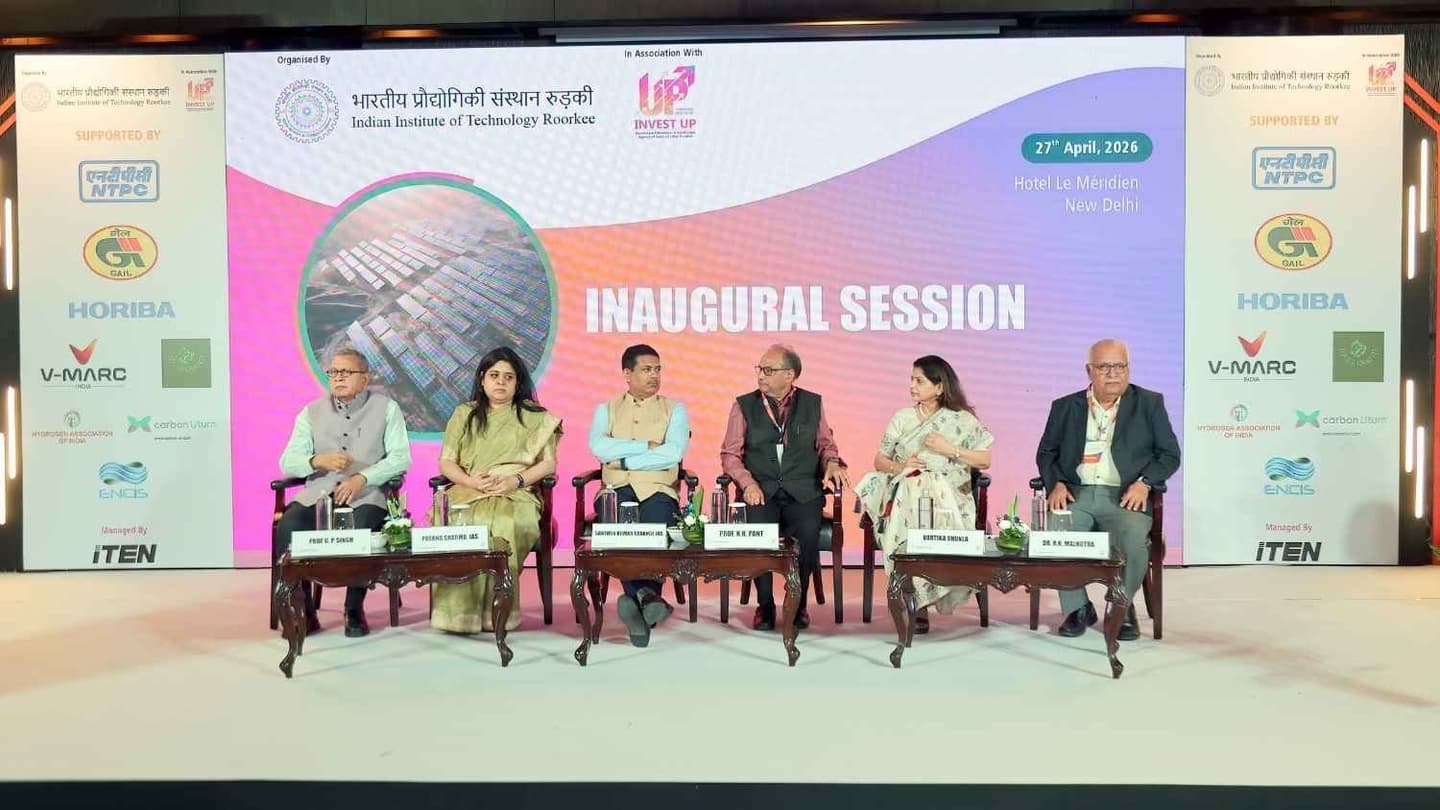
Held on April 27 in New Delhi, the National Policy Workshop on ‘Advancing Renewable Energy Policy for Uttar Pradesh’ emerged as a high-level platform for dialogue on India’s evolving energy transition. Convened by the Indian Institute of Technology Roorkee in association with Invest UP, the workshop brought together senior policymakers, industry leaders, researchers and institutional stakeholders to deliberate on scaling renewable energy in one of the country’s most critical states.
Positioned as an invite-only engagement, the workshop focused on aligning the state’s policy ecosystem with national clean energy ambitions, while benchmarking best practices across states and sectors. With India navigating rising energy demand alongside global uncertainties, discussions centred on how solar, bioenergy and green hydrogen can collectively shape a resilient, low-carbon growth pathway.
The deliberations reflected a broader shift from policy intent to execution, with emphasis on investment facilitation, technological integration and institutional collaboration. As one of India’s largest and fastest-growing states, Uttar Pradesh’s approach to renewable energy is increasingly being viewed as central to the country’s overall transition strategy.
We have three policies: UP Solar Policy, UP Bio Energy Policy 2024 and UP Green Hydrogen Policy 2024. We have targets under each of these policies and are working towards them
Driving Policy through Targets and Implementation
Outlining Uttar Pradesh’s structured policy approach and implementation momentum across renewable segments, Pankaj Singh, Secretary & Chief Project Officer at Uttar Pradesh New and Renewable Energy Development Agency, informed: “We have three policies: UP Solar Policy, UP Bio Energy Policy 2024 and UP Green Hydrogen Policy 2024.
We have targets under each of these policies and are working towards them. Under the UP Solar Policy, we have a target of 22,000 MW, and we are trying to achieve this by March next. Under the UP Bio Energy Policy 2024, we have set a target of 1,000 tons of CBG per day. Under UP Green Hydrogen Policy 2024, our target is 1 MMT green hydrogen per annum.”
Renewables as the Core of India’s Energy Future
Placing the discussion in a national and global context, Santosh Kumar Sarangi, Secretary, the Ministry of New and Renewable Energy (MNRE), linked energy growth to energy security. “It is very clear and evident that going forward, India’s energy transition and the least cost energy transition pathway is going to come from renewables. While talking of renewables, I will emphasise three particular aspects: one is in terms of green energy deployment; the second will be green manufacturing and green jobs, and the third is in terms of green innovation and research.” Sarangi also pointed to the need for grid modernisation, storage solutions and domestic manufacturing, stressing that innovation and research will be critical for sustaining momentum in the energy transition.
Integrating Pathways for a Sustainable Energy Future
Dr KK Pant, Director, Indian Institute of Technology Roorkee, emphasised the complexity of the energy transition, highlighting that sustainability cannot be addressed through a single solution. “As far as sustainability is concerned, there are a lot of challenges when we look at 1,000 GW of energy, which is required by 2030 and out of that, 500 GW is to be achieved through renewable sources. What kind of renewable sources, whether it is solar, wind, tidal, geothermal, nuclear or maybe multiple biomass, we talk a lot of things.”
He underscored the need to address emissions alongside energy growth, particularly in a coal-dependent economy. “We know that demand for energy is increasing exponentially, and besides that, when we talk about the fossil-derived feed stocks, how can we capture the carbon dioxide? And because coal will still be dominating in India, high in ash, is considered as a dirty raw material, but we need to make it clean and more and more sustainable. So capture all the carbon dioxide and other impurities and utilise it effectively.”
Uttar Pradesh have had 4.7 lakh connections under the PM-Surya Ghar: Muft Bijli Yojana and 3.7 lakh sanctions under the PM-KUSUM
Aligning Scale, Policy and Investment Execution
Framing the discussion within the broader national context, Prerna Sharma, Additional Chief Executive Officer (ACEO) of Invest UP, said: “India’s energy demand is set to double in the coming decades, and how we decide to meet it is going to determine our future.”
Sharma emphasised the state’s scale and significance, underscoring that every sixth Indian comes from UP, making its energy trajectory central to national outcomes. She also pointed to the state’s progress across flagship schemes, “We have had 4.7 lakh connections under the PM-Surya Ghar: Muft Bijli Yojana and 3.7 lakh sanctions under the PM-KUSUM (Pradhan Mantri Kisan Urja Suraksha evam Utthaan Mahabhiyan). She also highlighted investment momentum, noting that utility-scale solar projects have attracted ₹33,000 crore, with an additional ₹86,000 crore pipeline in PSP projects.
Scaling Hydrogen, Bioenergy
Dr RK Malhotra highlighted the role of ethanol, bioenergy and hydrogen in India’s energy transition. He said the green hydrogen target of 5 million tons by 2030 will require about 125 GW of renewable power. However, infrastructure remains a key challenge. “At times, it can be more than the cost of producing hydrogen.” With hydrogen demand expected to rise from around 7 million tons to 13–14 million tons by 2030, he noted the opportunity lies in increasing production. He also pointed to carbon capture, utilisation and carbon credit mechanisms as part of the transition.
By bringing together key stakeholders in a focused, high-level setting, the platform reinforced Uttar Pradesh’s ambition to emerge as a major renewable energy hub. As India moves towards its long-term climate and energy goals, such dialogues are likely to play a crucial role in shaping actionable pathways and sustaining momentum across the sector.