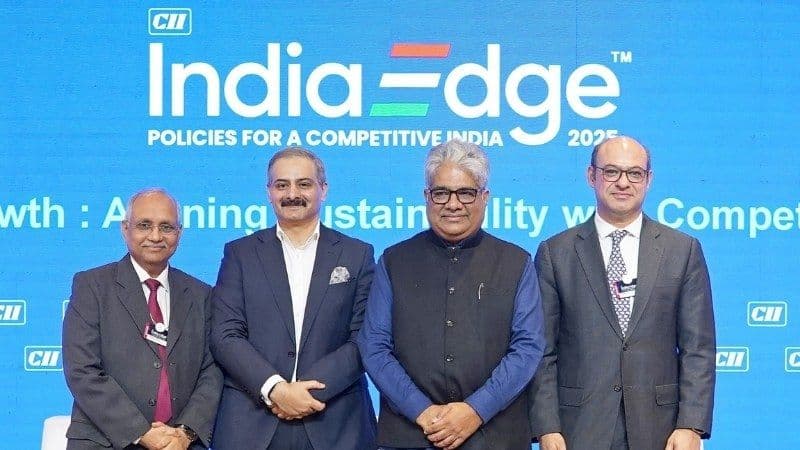
The Union government has reiterated that clean industrialisation is central to India’s long-term economic strategy, positioning it as essential for export competitiveness, technological resilience and sustained growth. The view was articulated recently at a conference in New Delhi, where Union Environment Minister Bhupender Yadav set out the policy direction for aligning industrial expansion with sustainability objectives.
“Clean industrialisation is not a constraint; it is a catalyst for economic expansion, innovation, resilience, and future prosperity,” Yadav said at the CII IndiaEdge 2025. The union minister added that India’s growth trajectory under ‘Viksit Bharat@2047’ requires a decisive shift towards greener manufacturing systems. He noted that decarbonisation has become a strategic necessity as climate-linked trade requirements increasingly shape global market access.
Yadav highlighted key elements of the GST 2.0 reforms, including reduced tax rates on renewable-energy equipment, biodegradable plastics, effluent-treatment plants and electric vehicles, saying these measures support the expansion of green manufacturing and enhance supply-chain sustainability.
The union minister also outlined a series of ongoing government initiatives designed to strengthen industrial sustainability, such as the scheme to promote manufacturing of sintered rare earth permanent magnets, the National Critical Mineral Mission 2025, the revised Green Credit Programme and the Environment Audit Rules 2025.
Referring to developments at CoP30, he said the 29 decisions adopted at the conference reflected India’s priorities on climate finance, unilateral trade measures, technology access and just transition. Yadav noted the establishment of the Technology Implementation Programme and a new institutional arrangement to support just-transition pathways.
The role of circular-economy systems and Extended Producer Responsibility (EPR) was emphasised as key to formalising waste-sector workers, strengthening recycling ecosystems and generating green employment. Strengthened EPR mechanisms, he said, have the potential to create up to 33 lakh jobs.
The minister called on industry to integrate sustainability with competitiveness through greater investment in R&D, green manufacturing and MSME collaboration, noting that India’s green-transition pathway offers significant opportunities to build a self-reliant and globally competitive industrial base.