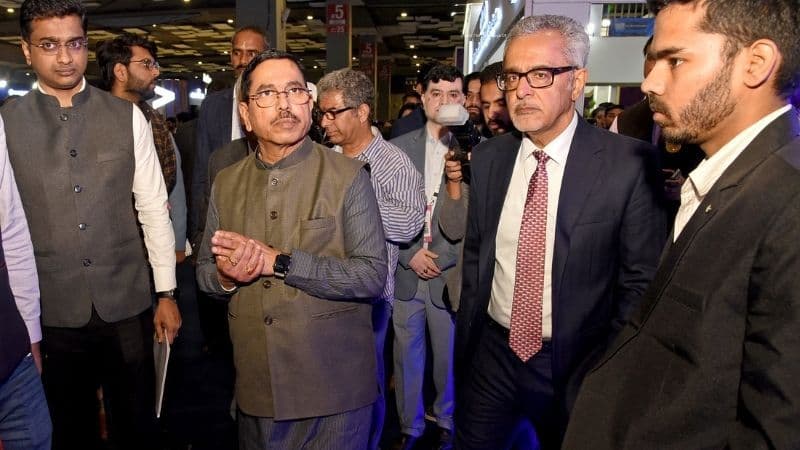
Union Minister for New and Renewable Energy Pralhad Joshi has said India’s energy transition must be matched by a parallel grid transition, as the country accelerates renewable capacity addition and adopts artificial intelligence (AI)-driven tools for power system management.
Speaking during his visit to the International Solar Alliance (ISA) Pavilion at the India AI Impact Summit 2026 at Bharat Mandapam, Joshi reviewed a series of digital innovations under the Global Mission on AI for Energy that aim to modernise utilities and strengthen renewable energy integration.
He said that as distributed renewable energy expands rapidly, the focus must shift from simply adding capacity to integrating millions of decentralised assets into a stable and reliable grid. This, he noted, requires stronger transmission infrastructure, modernised distribution systems, and real-time monitoring supported by data-driven forecasting and optimisation tools.
The summit highlighted how AI-driven compute and digital platforms are reshaping renewable energy planning, enabling smarter grid management and improving resilience across ISA member countries.
India’s solar capacity has grown from less than 3 GW in 2014 to over 141 GW at present, positioning the country among the world’s fastest-growing solar markets. The Minister underlined that India’s solar expansion is not only about megawatts installed but also about democratising energy access.
Under PM-KUSUM, farmers are installing solar pumps and participating in feeder-level solarisation, reducing diesel dependence and improving daytime power reliability. The PM Surya Ghar: Muft Bijli Yojana, which targets one crore households, is aimed at expanding rooftop solar adoption and transforming consumers into prosumers.
With 125 member and signatory countries, the ISA is positioning AI-enabled renewable integration as a scalable model for developing economies. The pavilion showcased innovations such as BSES Rajdhani Power Limited’s “One Solar App”, which streamlines rooftop solar adoption through digital registration and net-metering processes, as well as digital twin solutions for distribution companies that allow real-time simulation and predictive maintenance.
Geospatial mapping initiatives, including those undertaken by Andhra Pradesh Eastern Power Distribution Company Limited, were also highlighted as tools to improve outage management, infrastructure planning and renewable integration.
Joshi said that the convergence of solar, storage, smart grids and AI would define the future energy system, adding that India stands ready to partner with ISA member countries to advance cleaner, smarter and more resilient energy infrastructure.