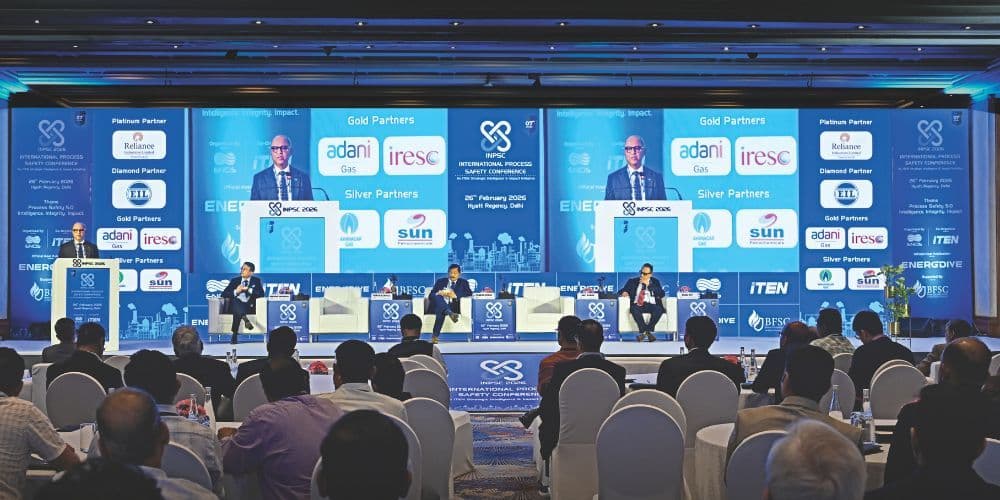
As industries expand into increasingly complex sectors such as petrochemicals, Liquefied Natural Gas (LNG) infrastructure, hydrogen energy and semiconductor manufacturing, the demands placed on process safety systems are evolving rapidly.
The 7th International Process Safety Conference (INPSC) organised by The Energy & Climate Initiatives Society (ENCIS) and co-organised by ITEN Media Pvt Ltd, held on February 26 in New Delhi, provided a platform for regulators, corporate leaders and safety experts to explore how industrial safety frameworks must adapt to this changing environment.
The conference centred on the theme ‘Process Safety 5.0: Intelligence. Integrity. Impact.’, signalling a transition from traditional compliance-based safety models to predictive, intelligence-driven safety ecosystems. Across keynote addresses, leadership discussions and technical sessions, participants examined how emerging technologies such as Artificial Intelligence (AI) and digital monitoring systems are reshaping safety management while reaffirming the central role of leadership accountability and behavioural safety.
Throughout the conference, discussions repeatedly emphasised that although technology can significantly enhance operational monitoring and risk prediction, the effectiveness of safety systems ultimately depends on human judgement, organisational culture and operational discipline.
Leadership Accountability in High-hazard Industries
The conference opened with a keynote address by Amit Kumar, CMD of AI Assets Holdings Ltd and Chairman of Air India Engineering Services Ltd (AIESL).
Drawing on his experience in both the upstream oil and gas sector and the aviation industry, Kumar reflected on the inherent risks associated with high-hazard industries and the growing complexity of modern operations.
He observed that industries are increasingly relying on AI, automation and digital systems to improve operational efficiency and predict equipment failures. At the same time, these technologies introduce new vulnerabilities, including cyber threats and operational dependencies on digital infrastructure.
Kumar emphasised that safety must be treated as a strategic leadership priority rather than merely a regulatory obligation. In sectors such as aviation, he noted, senior leadership carries direct accountability for safety outcomes.
A similar level of responsibility, he argued, must be embedded across all industrial sectors. According to Kumar, organisations must move beyond reactive safety frameworks towards proactive systems that use operational data and predictive intelligence to anticipate risks before they escalate into incidents.
Regulatory Challenges in an Expanding Industrial Landscape
Providing a regulatory perspective, Pranab Kumar Goswami, Deputy Director of Industrial Safety and Health in the Labour Department of the Government of NCT of Delhi, addressed the implications of rapid industrialisation for safety governance.Goswami noted that India is witnessing expansion across multiple sectors, including petrochemical clusters, LNG terminals, green hydrogen projects, Electric Vehicle (EV) battery manufacturing and semiconductor fabrication facilities. While these developments support economic growth, they also introduce unfamiliar operational hazards. He highlighted the importance of strengthening regulatory frameworks through the Occupational Safety, Health and Working Conditions Code (OSHWC Code) 2020.
The code aims to expand safety coverage across workplaces and improve accountability within industrial establishments. A significant concern raised during his address was the disparity between the organised and unorganised sectors of the workforce. While the organised sector operates under formal safety frameworks, a large portion of workers remain outside these systems. Goswami stressed that effective safety governance must address this gap by extending safety awareness, training and regulatory oversight across the broader workforce.
Leadership Panel: Aligning Operations, Culture and Sustainability
One of the central discussions of the conference was the leadership panel ‘The Safety Vanguard: Aligning Operations, Culture and Sustainability.’ Moderated by Dr SP Garg, former Executive Director of GAIL (India) Ltd, panelists were Arun Mittal, Executive Director of the Oil Industry Safety Directorate (OISD); Rituraj Mehta, Group Head for Safety at Adani Enterprises Ltd; Yatendra Lodha, Group Head, Safety & Operational Risk at Reliance Industries Ltd; Mukesh Mohan, Executive Director, HSE, Refinery HQ, at Indian Oil Corporation Ltd (IOCL); and Swapnil Kamulkar, Global Head, Road Transport Assurance, Safety and Optimisation at Shell India.
The panel explored how leadership decisions shape safety culture within large organisations. Speakers emphasised that operational discipline, workforce engagement and sustainability commitments must be aligned with safety objectives. The discussion also highlighted the importance of integrating safety performance into broader environmental, social and governance (ESG) frameworks.
Human Performance and Organisational Culture
A recurring theme throughout the conference was the interaction between human behaviour and complex industrial systems. Vipul Shukla, Deputy Manager, Safety at HPCL-Mittal Energy Ltd (HMEL), presented the organisation’s safety culture transformation programme. The framework integrates human performance principles with structured operational discipline tools and leadership engagement.
Shukla explained that traditional safety systems rely heavily on procedures and engineering safeguards. However, many real-world incidents occur at the intersection of human behaviour and system complexity. The company’s framework aims to address this challenge by strengthening communication, improving workforce engagement and encouraging employees to identify risks proactively. He stressed that psychological safety is essential in operational environments. Workers must feel empowered to report hazards and question unsafe practices without fear of consequences.
AI and Predictive Safety Systems
Several technical sessions explored how digital technologies are transforming safety management systems. Speakers explained that AI and predictive analytics now allow organisations to analyse large volumes of operational data in real time. These technologies can detect subtle deviations in process parameters, equipment performance or operational conditions that may indicate emerging risks.
The discussions highlighted the growing use of digital twins, sensor networks and advanced data analytics to anticipate equipment degradation and improve asset integrity management. However, participants cautioned that AI should complement human expertise rather than replace it. Operational knowledge and engineering judgement remain essential for interpreting complex data patterns and making informed safety decisions.
Learning from Operational Incidents
The importance of organisational learning was examined in detail during a technical session led by Devendra M Mahajan, Deputy General Manager (Technical Services) at IOCL’s Gujarat Refinery. Mahajan presented an analysis of accident data from the oil and gas sector over the past two decades. His study identified recurring patterns in industrial incidents, including violations of Standard Operating Procedures (SOP), inadequate hazard identification and insufficient training. He emphasised that many accidents occur not because organisations lack knowledge about safety risks, but because lessons from previous incidents are not consistently implemented.
Another presentation by Dilip Paigude, Assistant General Manager for Process Safety Management (PSM) at HMEL, focused on the role of weak signals in preventing major incidents. He explained that small operational deviations, near-miss events and operator observations often provide early warnings of systemic risks.
Capturing and analysing these signals through structured reporting systems can help organisations detect emerging hazards before they escalate into catastrophic failures.
International Process Safety Conference (INPSC) 2026: Leadership Takeaways
Leadership Accountability
Safety must be embedded in strategic decision-making at the highest organisational level
Workforce Engagement
Safety culture depends on empowering workers to identify and report risks
Predictive Technologies
AI and digital analytics enable earlier detection of operational hazards
Organisational Learning
Incident analysis and near-miss reporting are critical for preventing recurring failures
Mechanical Integrity
Continuous monitoring and maintenance of equipment remain essential for process safety
Regulatory Governance
Expanding safety coverage across the broader workforce remains a key challenge
Mechanical Integrity and Asset Reliability
Mechanical integrity was another major focus of the conference. Muruganantham Boosapathi, Safety Engineer, Quality & HSE Team, Project Support Services Group, at Kuwait Oil Company discussed international best practices for pressure equipment integrity and incident investigation.
Boosapathi explained that catastrophic industrial incidents are often preceded by seemingly minor equipment issues such as corrosion under insulation, gasket failures or structural fatigue. Identifying and addressing these warning signs through rigorous inspection and maintenance programmes is critical for preventing major accidents. He emphasised that mechanical integrity programmes must be integrated with broader process safety management (PSM) systems, including hazard identification, contractor management and operational readiness reviews.
The discussions at the INPSC 2026 highlighted the evolving nature of industrial safety in an increasingly digital and complex operational environment. While AI, predictive analytics and digital monitoring systems are transforming the way organisations detect and manage risks, the conference reinforced a clear message: technology alone cannot guarantee safety.
Effective safety systems require leadership commitment, regulatory oversight and a strong organisational culture that prioritises accountability and learning. As industries continue to expand into new sectors and adopt advanced technologies, the challenge will be ensuring that safety frameworks evolve at the same pace. Ultimately, the conference underscored the importance of combining intelligent technology with disciplined operations and responsible leadership to build resilient industrial systems.