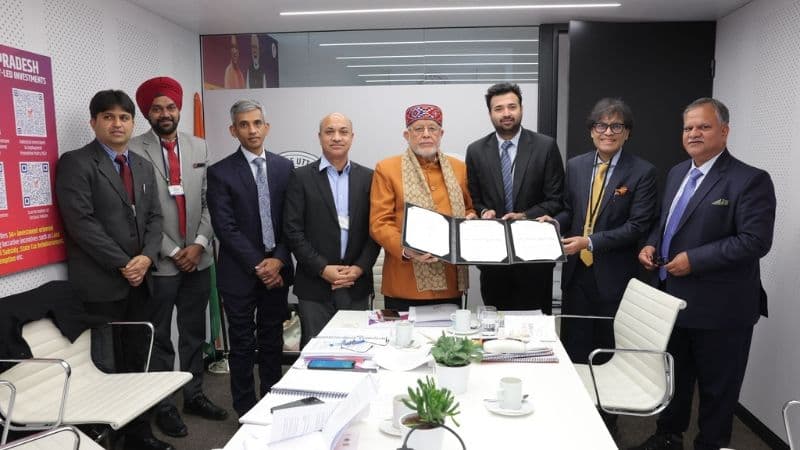
India used the World Economic Forum Annual Meeting 2026 in Davos to reinforce its position as a key destination for long-term clean energy investment, with global companies and governments expressing interest in partnerships across renewables, hydrogen, storage and manufacturing.
Union Minister for New and Renewable Energy Pralhad Joshi said discussions at the forum strengthened confidence in India’s energy transition roadmap, which is built around policy stability, scale and execution capacity.
India highlighted its progress in renewable energy deployment, including achieving 267 GW of non-fossil fuel installed electricity capacity and reaching 50 percent non-fossil capacity five years ahead of its 2030 climate target. Officials said India would require $300–350 billion in investment to reach 500 GW of non-fossil capacity by 2030, and invited global investors to partner in this expansion.
Bilateral meetings were held with ministers and officials from Oman, Belgium, Kuwait, Paraguay and Zimbabwe to explore cooperation in renewable energy deployment, green hydrogen and storage, particularly for emerging economies.
Executives from global energy companies including TotalEnergies, Engie, EDF, Acciona, Mercuria and Ingka Group discussed expanding their clean energy footprint in India, while multilateral agencies such as the International Energy Agency and the International Atomic Energy Agency explored avenues for technical collaboration.
Artificial Intelligence (AI) and digital public infrastructure for energy also featured in discussions, with India presenting technology-driven solutions to improve forecasting, grid reliability and system efficiency as renewable capacity scales up.
Officials said the Davos engagements reflected a shift in India’s global positioning—from a fast-growing energy market to a driver of the global energy transition.