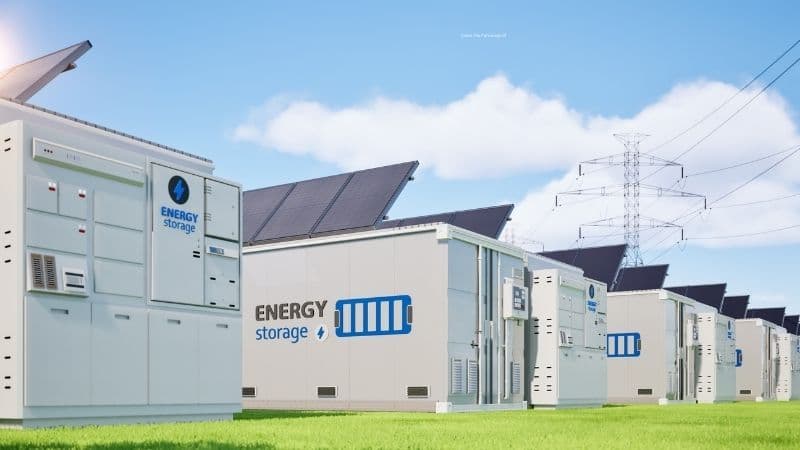
India will require 60.63 GW of energy storage capacity by 2029-30 comprising 18.98 GW from pumped storage projects (PSP) and 41.65 GW from battery energy storage systems (BESS) to support large-scale renewable integration, the Minister of State for New and Renewable Energy Shripad Yesso Naik informed the Rajya Sabha, citing estimates in the Central Electricity Authority’s Optimal Generation Mix 2030 report.
To accelerate deployment, the government has approved two viability gap funding (VGF) schemes: ₹3,760 crore for 13,220 MWh of BESS at ₹27 lakh/MWh and ₹5,400 crore for 30 GWh at ₹18 lakh/MWh. It has also granted 100 percent waiver of Inter-State Transmission System (ISTS) charges for PSP projects awarded and co-located BESS commissioned by June 30, 2028.
Under the National Programme on Advanced Chemistry Cell Battery Storage, 10 GWh has been earmarked for grid-scale applications. Advisory guidelines have been issued to promote co-location of storage with solar projects, while research funding is being extended through the Renewable Energy Research and Technology Development Programme and the Department of Science and Technology’s Clean Energy Material Initiative.
As of December 31, 2025, renewable energy implementing agencies such as Solar Energy Corporation of India (SECI), NTPC Ltd, NHPC Ltd and SJVN Ltd have issued letters of award for about 69 GW, with power purchase agreements signed for 24.3 GW. Falling costs of renewable-plus-storage solutions are prompting distribution companies to shift toward Firm and Dispatchable Renewable Energy (FDRE) procurement instead of plain solar or wind contracts.
Also, the centre has urged states to comply with renewable consumption obligations and advised agencies to aggregate demand before issuing bids to speed up Power Purchase Agreement (PPA) signing.