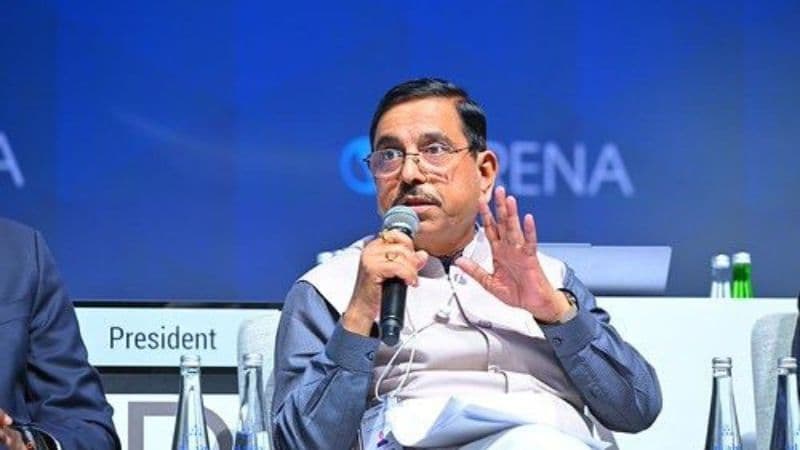
Union Minister for New and Renewable Energy Pralhad Joshi has said India’s approach to energy transition is guided by equity, inclusivity and policy stability.
The minister said India’s long-term vision is anchored in the principle of ‘Vasudhaiva Kutumbakam’ — One Earth, One Family, One Future — and reiterated the country’s commitment to achieving 500 GW of non-fossil fuel installed power capacity by 2030 and Net Zero emissions by 2070.
Joshi said India has already achieved 50 percent of its installed electricity capacity from non-fossil fuel sources in 2025, five years ahead of its Nationally Determined Contribution (NDC) target under the Paris Agreement. India’s total renewable energy capacity has crossed 266 GW, placing it among the global leaders in renewable energy deployment.
He said India is prioritising reliable and resilient power systems through accelerated deployment of energy storage, grid modernisation, Green Energy Corridors, and procurement models such as hybrid and round-the-clock renewable energy projects. The minister also highlighted efforts to expand domestic manufacturing across solar, wind, batteries and electrolysers.
Referring to people-centric programmes, Joshi said initiatives such as the PM Surya Ghar: Muft Bijli Yojana have benefited around 2.5 million households through rooftop solar installations, with a target of covering 10 million households by March 2027. Under the PM-KUSUM scheme, about 2.17 million farmers have benefited through solarisation of pumps and agricultural feeders.
The minister said India is expected to require around $300 billion by 2030 to support its energy transition, creating opportunities across renewables, storage, green hydrogen, grids and manufacturing.