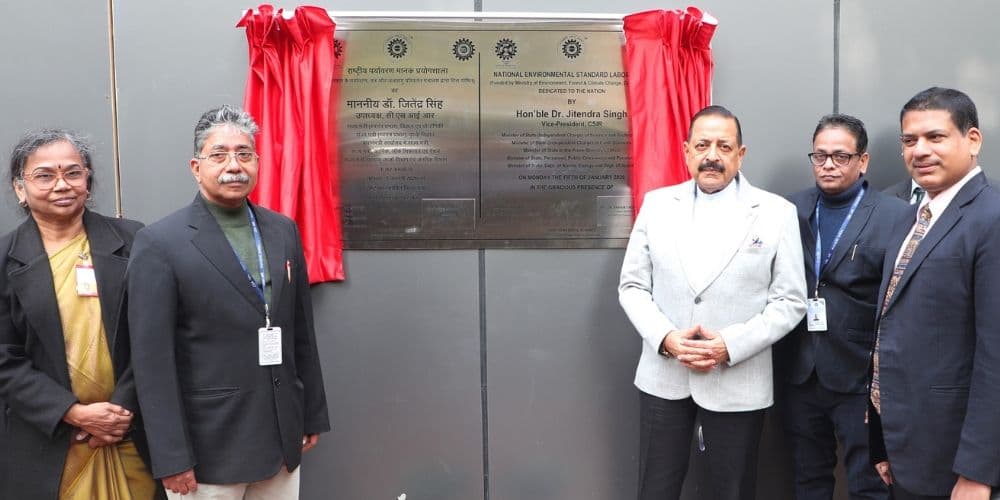
Two new national-level scientific facilities inaugurated at the CSIR–National Physical Laboratory (NPL) will strengthen India’s environmental monitoring framework and renewable energy ecosystem, Union Minister of State (Independent Charge) for Science and Technology Dr Jitendra Singh has said.
The facilities — the world’s second National Environmental Standard Laboratory and the world’s fifth National Primary Standard Facility for Solar Cell Calibration — were inaugurated during the 80th Foundation Day celebrations of CSIR–NPL.
Dr Singh said the National Environmental Standard Laboratory would enable India-specific calibration and certification of air pollution monitoring instruments, a long-pending requirement for transparent and traceable environmental data. He said the facility would support regulatory agencies, industries and startups by allowing instruments to be tested under Indian climatic conditions, thereby strengthening enforcement under programmes such as the National Clean Air Programme.
The minister described the Solar Energy Complex as a future-ready facility that places India among a select group of global leaders in photovoltaic measurement standards. Developed in collaboration with Physikalisch-Technische Bundesanstalt, the facility houses a laser-based Differential Spectral Responsivity (L-DSR) system that achieves the lowest global uncertainty of 0.35 per cent (k=2) for reference solar cell calibration.
Dr Singh said the facility would reduce India’s dependence on overseas certification agencies, save foreign exchange, shorten calibration timelines and improve investor confidence in the country’s rapidly expanding solar sector.
Emphasising the role of science and technology in India’s long-term development, the minister said institutions such as CSIR–NPL reflect the country’s scientific journey from pre-Independence foundations to global technological leadership. He noted that CSIR predates independent India, making NPL one of the earliest among its 37 laboratories, and recalled its historic role in establishing Indian Standard Time through the atomic clock housed at the laboratory.
Dr Singh added that Indian scientists are today central to national aspirations and no longer work in isolation within laboratories.